

01
Fuel polishing
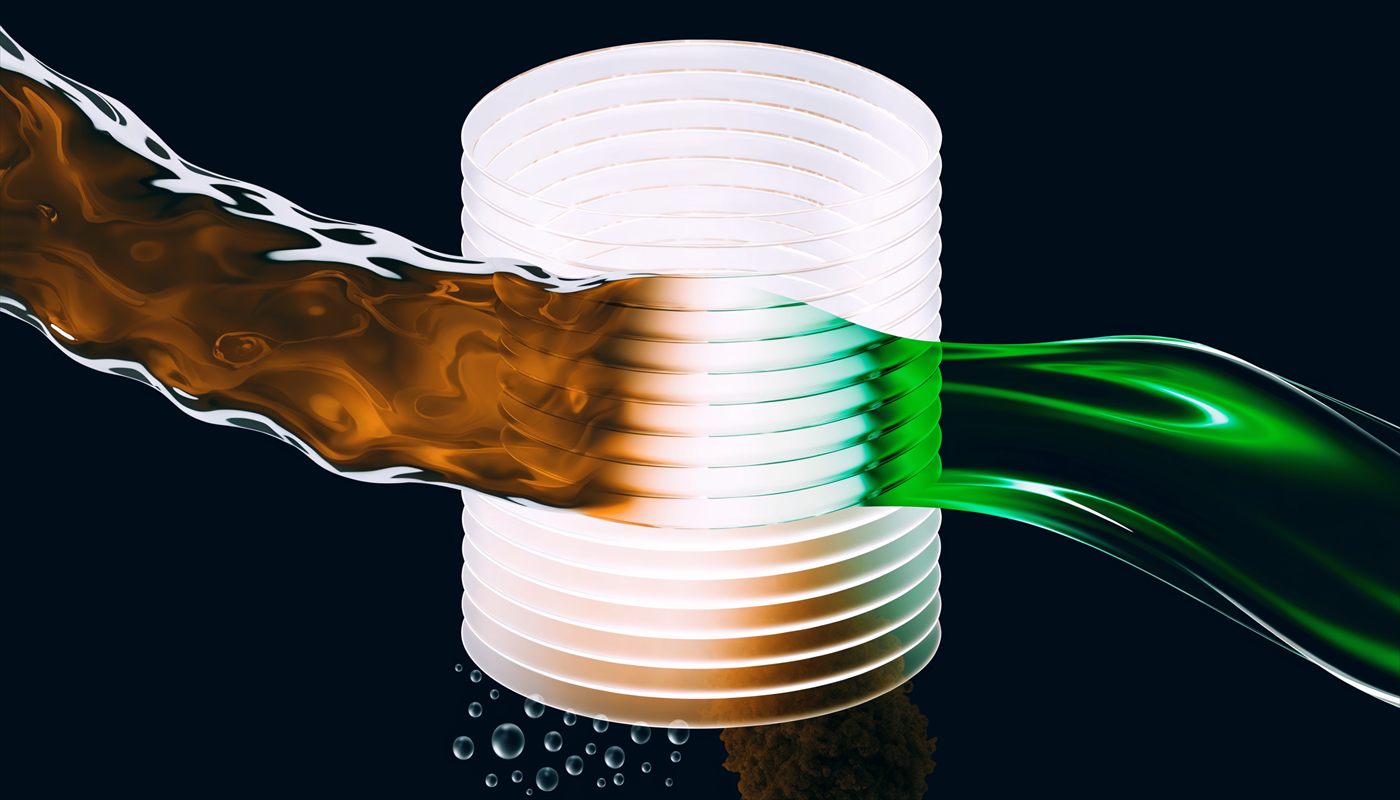
Recirculating conditioning through coalescing water separation and staged filtration, sized to tank volume. Runs on the tank in service, drawing from the low point where the contamination actually sits.
Division 02. Fuel management
Diesel bought to specification does not stay on specification. Sitting in a warm, humid tank it picks up water, grows microbial colonies at the fuel–water interface, drops out sludge and blinds filters. On standby plant, the first anyone knows is a generator that will not take load.
01. What goes wrong
None of these are visible by looking in the tank. All of them are visible in a sample drawn from the right point.
Biodiesel content makes all four worse: FAME blends hold more dissolved water and are a better nutrient source than straight mineral diesel.
02. What we do about it
A single polish on a neglected tank buys months. Removing the water that feeds the problem buys years.
01
Recirculating conditioning through coalescing water separation and staged filtration, sized to tank volume. Runs on the tank in service, drawing from the low point where the contamination actually sits.
02
Removal of accumulated sludge, water bottoms and biomass, including manual entry cleaning where the deposit load is beyond what circulation will lift.
03
Testing to confirm an active population before anything is dosed, then a biocide selected for the fuel and the organism, with a follow-up test to prove the kill.
04
Tank low-point draining routines, desiccant breathers on vents, and water-detecting paste or sensors so the bottom is checked on a schedule rather than on suspicion.
05
Full quality panel on delivery and in storage, so a bad load is caught at the gate rather than three months later in an engine.
06
A scheduled programme for generation that rarely runs: calendar-based sampling, polishing intervals and stock rotation, because run hours tell you nothing about a tank.
03. The limits
Published methods and specification limits. Where a client's engine OEM sets a tighter figure, the OEM figure governs.
| Property | Method | Typical limit | What it catches |
|---|---|---|---|
| Water & sediment | ASTM D2709 | ≤ 0.05 % vol | Free water and gross solids carried in the fuel |
| Appearance | ASTM D4176 | Clear & bright | Haze from suspended water, the fastest field check there is |
| Cleanliness code | ISO 4406 | 18/16/13 | Particulate load against modern common-rail requirements |
| Particulate contamination | ASTM D6217 | ≤ 10 mg/L | Total solids by filtration, gravimetric |
| Microbial activity | ASTM D7687 | Negligible | Live biomass by ATP, distinguishes an active colony from dead debris |
| Oxidation stability | ASTM D2274 | ≤ 25 g/m³ | Tendency to form gums and sludge in long storage |
| Flash point | ASTM D93 | ≥ 52 °C | Contamination by a lighter product, a safety issue, not a performance one |
| Density at 15 °C | ASTM D4052 | 820–845 kg/m³ | Whether the product is what the delivery note says it is |
Note for the Malina team: confirm every limit in this table against the fuel specification you contract to and the engine OEM manuals you support, and confirm which of these tests you run in-house versus subcontract, before this page is published.
Start with the tank
A bottom sample and a full panel will tell you whether you have a water problem, a microbial problem, or no problem at all.